

A while ago we were consulting a leading publication. I was tasked to put together a strategy proposal to drive readership, increase subscriptions and build brand affinity. Essentially common business objectives for any brand in the subscription economy — whether it is Netflix, StarzPlay or OSN in the OTT space to Spotify, Apple Music, Anghami or Deezer in the music streaming industry.
However we realized the news publishing industry seemed to have a unique challenge. Readers across the board had one common critique about the newspaper: negative news fatigue.
With the onset of the pandemic this issue has become amplified further. Readers ask why can’t there be a newspaper that shares positive news stories that are inspirational and provide hope.
When I saw yesterday’s Guardian, I realized this appears to be a category norm.
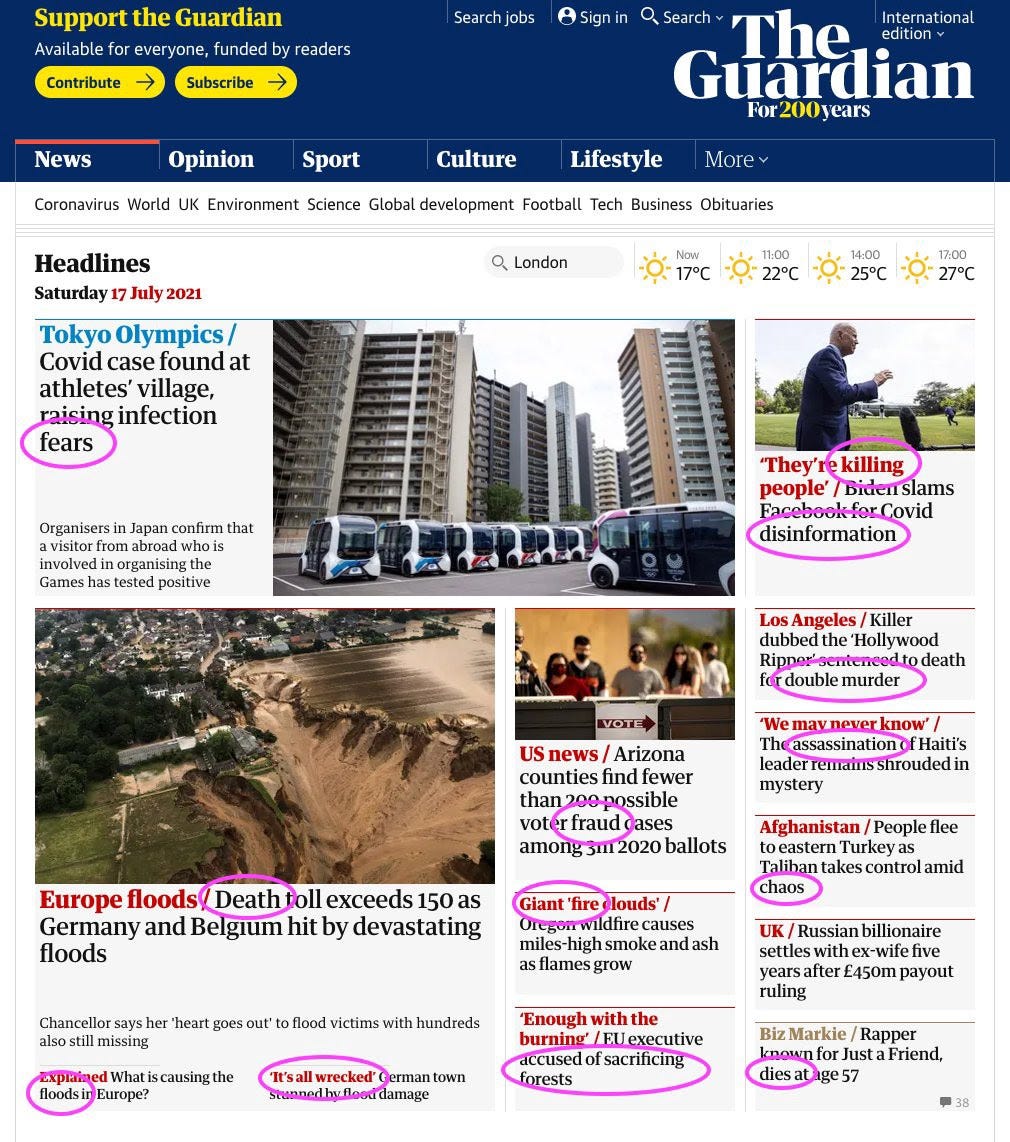
This got me wondering if this was by design. While investigating further, I stumbled upon a fantastic talk on ‘Why our brains crave negativity’ hosted by Phill Agnew. (Founder and host of a brilliant podcast Nudge. Must follow it, if you aren’t already).
He quotes several studies during the show, illustrating how our focus is unconsciously drawn to negativity over positivity.

Research by Kelly Goldsmith and Ravi Dhar suggests how negativity can make us more likely to complete a task when the task is framed as a means to avoid the loss of something compared to a chance to gain — classic loss-aversion. Additional studies have shown that negative news is more likely to be perceived as truthful since negative information draws greater attention. Increase in the level of attention apparently also makes negative news seem more believable, regardless of the source of the news. And this possibly explains the tsunami of fake news on platforms like whatsapp.
Another study by J Kiley Hamlin, Karen Wynn and Paul Bloom showed that bias towards negativity isn’t something we develop as adults later in life, but it is visible from birth. Infants as young as 3 months old pay greater attention to negative stimuli.
In 2013, a group of Canadian researchers from McGill University set up a test to see if readers preferred negative or positive news. But before taking part in the test, the participants were asked what type of news stories they preferred and the participants as expected overwhelmingly stated they preferred positive articles. And yet the study showed these same participants routinely opened more negative articles than positive articles in the test. Not surprisingly we might all say we prefer these positive news stories, but often we don’t even get around to reading them as we are so drawn in by negative articles. Perhaps this is the reason why we as marketers must not trust what consumers tell us, but instead trust what they do.
Another study analyzed 65000 online news articles. Researchers found that articles with positive headlines performed 29% worse than the negative headlines. They also found that negative articles have a 63% higher click-through rate. Data shows we are more likely to open, remember and engage with negativity.
More recently, a few researchers examined which stories were the most read or the most shared on Facebook. They tended to be the most negative stories.
Phill says all of us are wired to dwell on negativity, with a natural tendency to notice and record negativity in the world. It is not surprising that we witnessed a known political figure leverage this negativity bias successfully.
This poses a huge dilemma for news publishers, as we are all prone to derogating those who tell us things we don’t want to hear — we shoot the messenger.
With this negativity-bias at play, every publisher will need to draw a fine balance of having the right tone and messaging to build brand affinity whilst attempting to drive high click-through rates and readership, via negative, sensational headlines.